Book Nine: South-Southwest
I. ONE YEAR LATER
The latency was almost inconceivable — the kind of thing that required years of attention to a specific system to detect. The difference was not measured in seconds, but in the quality of the pause before the answer. Most people would not have noticed. Most people had not been watching Dors from the Roof since they were old enough to stand there.
Raven noticed.
She kept it unrecorded. She told no one.
Because some things, named, become only themselves. Unnamed, they remain surrounded by everything else. She wanted Dors surrounded by everything else for as long as possible.
II. THE SHIPYARD
The shipyard had once been a graveyard for cruise liners, their white hulls run aground and left to rust in slow ceremony. After the flood, the sea lifted them back into usefulness, stripping them of grandeur but not of structure; they drifted now in uneven rows, balconies barnacled, ballrooms gutted, their names still faintly visible beneath salt and time. It had the architecture of a cathedral, though no one had meant it to.
Everyone disembarked.
The survivors spread into the shipyard the way people spread into large spaces — gradually, then completely, drawn by different things, the curiosity of people who have been on the same platform long enough that any change of scale feels significant.
Raven walked.
She walked the way she walked places she didn’t yet understand — without destination, with attention, letting the space explain itself at its own pace. Past the cruise liners with their ghost-names. Past smaller vessels in various states of restoration. Past a drydock where three people were arguing quietly about a keel.
She found Luc the way she usually found Luc — by following the stillness.
He was standing in front of a ship.
It was large. Not the largest in the shipyard, but large in the way that mattered — the kind of large that had been built for serious purpose and had, after considerable weather, proven it. Its hull was dark and salt-worn and bore the evidence of storms not just survived but absorbed, the dents and scoring of a vessel that had been tested repeatedly and had each time declined to fail entirely.
The name on the bow was almost gone. Salt and time had done their work. But almost gone is not gone, and in the right light, at the right angle:
THE LUXEMBOURG.
The man who found them had the look of someone who had been on the Luxembourg long enough to have stopped distinguishing between himself and the ship — the weathered quality of a person shaped by the same forces that had shaped the hull behind him.
He started talking the way people talk when they have been through something and have not yet finished processing it — not to explain, exactly, but because the talking was part of the processing.
The SegFault Channel. Two days ago. The storm had come from the northwest without adequate warning, which meant no warning. That was the Channel’s reputation and its habit. The captain had gone in the second hour. The navigator in the third.
The crew had brought the Luxembourg through on collective experience and mutual stubbornness. They had made it here. They were going, eventually, to a trade post they had heard about, not far from the Northern Provisional Station.
He listed the Luxembourg survivors on board.
Among them: seventeen from a place that had gone under early. A place that had been, before the flood, a country.
Luc said: “Luxembourg.”
The man looked at him.
“Yes,” he said. “You know it?”
Luc looked at the ship.
“Yes,” he said.
III. THE DECISION
It was not immediate.
Luc was seventeen. He was aware of this. The awareness was not insecurity exactly — it was the accurate calibration of someone who had been learning to distinguish between what he knew and what he looked like he knew, which are not always the same distance.
He knew the currents. He knew the charts. He knew the trade post — had navigated there more than once in the past three years. Without going through the Exclusion Zone.
He was seventeen.
He said this.
Dors said: “Your navigation record contains no errors in the past fourteen months.”
She said it as she said navigational facts. Simply.
Raven did not contradict it.
She did not add anything. She looked at Luc with the expression she had been giving him since he was fourteen on a barrel — not quite pride, the thing that lives in pride’s neighborhood.
Luc looked at the Luxembourg.
He looked at the name that was almost gone but not gone.
He said: “I’ll need charts. And someone who knows the northern approach to the post.”
The man from the Luxembourg said they had charts.
Dors said she knew the northern approach.
That afternoon, Luc decided.
IV. THE TRANSFER
It took all afternoon.
Some of the survivors from the Threshold II decided to go with Luc — not many, but enough. The ones who had been on the water longest. The ones for whom the name Luxembourg had settled into something like intention.
They moved between vessels in the unhurried way of people who have learned that hurrying rarely improves a transfer.
Dors copied charts. She worked with the focused efficiency of someone who understands that information shared loses nothing, gains everything. The Luxembourg’s new navigator would need what she had.
Luc packed the way he packed: quickly, correctly, with the instinct of someone who had been making do long enough to know the difference between what was necessary and what was merely familiar.
He gave Raven the book on fermentation.
He held it out and she looked at it for a moment — the waterlogged edges, the missing cover, the three absent final chapters, the book he had found at the first atoll and carried ever since — and she took it.
She hugged him.
Not long. The hug of someone who knows the person they’re holding is going toward the right thing. Her arms knew it before she did.
He got on the Luxembourg.
The Luxembourg needed more extensive repair before she could sail — a week, the man estimated, possibly two.
The Threshold II was preparing to cast off when the man came to the railing.
“One thing,” he said. “If you happen to pass through the SegFault Channel.” He paused. “You might still find our navigator there.”
Raven looked at him.
“The storm was two days ago,” she said. “And it would take us at least two days to get there.”
“Yes,” said the man. He said it with the particular tone of someone conveying information they cannot fully explain. “Consider it a trade. Now we’re even.”
Raven looked at Dors.
Dors looked at the man.
“What kind of navigator,” said Dors. Not a question exactly. The question was in the phrasing.
The man almost smiled.
“You’ll have to find out yourselves,” he said.
The Threshold II cast off.
Luc was at the Luxembourg’s railing. He raised his hand once.
Raven raised hers.
The platform moved.
The Luxembourg receded — salt-worn, barnacled, bearing its almost-gone name — and Luc remained at the rail until they were out of sight.
V. SEGFAULT
They discussed it that evening.
The SegFault Channel was two days north, maybe less with the current running the way it was running. The storm had moved northeast — Dors tracked it on the scanner with the focused attention she gave to things that required tracking, its edges fraying, its energy dissipating into the broader weather that was always present and mostly manageable.
“Southern approach,” said Raven. “If the signals are unstable, we turn back. If there’s someone alive, we’ll know.”
She paused.
“They would do the same,” she said. Quietly. Not to anyone specific.
Dors ran the calculations — storm reformation probability, return window, fuel margin, the arithmetic of a decision that was navigational on the surface and something else underneath.
“The risk is acceptable,” she said.
A pause that was not quite a pause.
“Your decision threshold has shifted,” she added.
Not criticism. Observation. The ledger noting a change in the data.
Raven looked at her.
“Yes,” she said.
They went.
The SegFault Channel was calm when they entered from the south. Drizzling — the light persistent rain of a sky that had recently been worse and was still considering its options. The water was grey-green and flat and gave nothing away.
The scanner picked it up forty minutes in.
A speck. The kind of reading that could be debris, a malfunction in the scanner itself, or the particular electromagnetic residue that storm-churned water sometimes produced for reasons Dors had filed under unclassified interference and left there.
“Could be anything,” said Raven.
“Yes,” said Dors.
They looked at each other.
They went in.
The Channel narrowed, the storm having rearranged it without consulting maps. The debris field was not dramatic. Sections of railing. A door without a frame. An overturned galley chair. Steel that had once belonged to something larger, now reduced to edges and angles.
The transmissions came fragmented, the way signals come when the thing transmitting them has been through something it was not designed to be survived:
ROUTE UNRESOLVED—
—STORM INDEX EXCEEDED OPERATIONAL PARAMETERS—
—RECALCULATING—RECALCULATING—
—HEADING: UNKNOWN. LAST KNOWN HEADING—
Then static. Then the fragments again, looping, patient, the transmission of something that had not decided to stop.
It was wedged against a section of hull plating — old, pre-flood manufacture, the kind of steel that had been built to last and had lasted, even here, even after. The robot had been pressed into the gap by the storm’s logic, which was not logic but force, and had stayed there, transmitting, because transmitting was what it did and the storm had not changed that.
It was damaged. Not catastrophically — the housing was intact, the primary systems running, the transmission itself evidence that something essential had survived. But damaged in the way that things are damaged when they have been through what this had been through.
“Leaving a navigator among debris,” said Raven.
“Would be misclassification,” said Dors.
They got out the fishing gear.
It was not elegant. It was the specific inelegance of a practical problem being solved with available tools by people who had learned that available tools, applied with sufficient patience, were usually enough.
The weighted line. The careful angle. The slow work of extracting something wedged without damaging what was already damaged.
The weather shifted mid-extraction — not dramatically, not the return of the storm, but a change in the wind’s direction that altered the platform’s drift by three degrees and required immediate compensation.
Dors miscalculated the drift.
Raven moved to the line and adjusted the angle and held the new position with the instinctive precision of someone who has been reading water long enough that the reading has become involuntary.
No one remarked on it.
The robot came free on the next pull.
VI. THE RETURN
They headed out of the channel.
Dors stood at the navigation console.
The pause before she gave the heading was 0.8 seconds.
Raven said the heading first.
Dors confirmed it.
Neither of them noted this in any report.
VII. PATCH
The robot could not be fully restored.
This was not immediately apparent — it powered on, its systems ran, it could receive and process input. But the memory was fragmented in the way memories fragment when the architecture holding them has been compromised repeatedly over time — accumulated damage rather than a single event.
It could not hold continuation. It would begin a process and lose the thread. It would access a file and find the file was there but the context around it was gone — data without its connections, information without its story.
Dors studied it quietly.
She studied it the way she studied things that required precision — with complete attention, without announcement, filing what she found and what she couldn’t find and the difference between them.
After some time she came to the Roof.
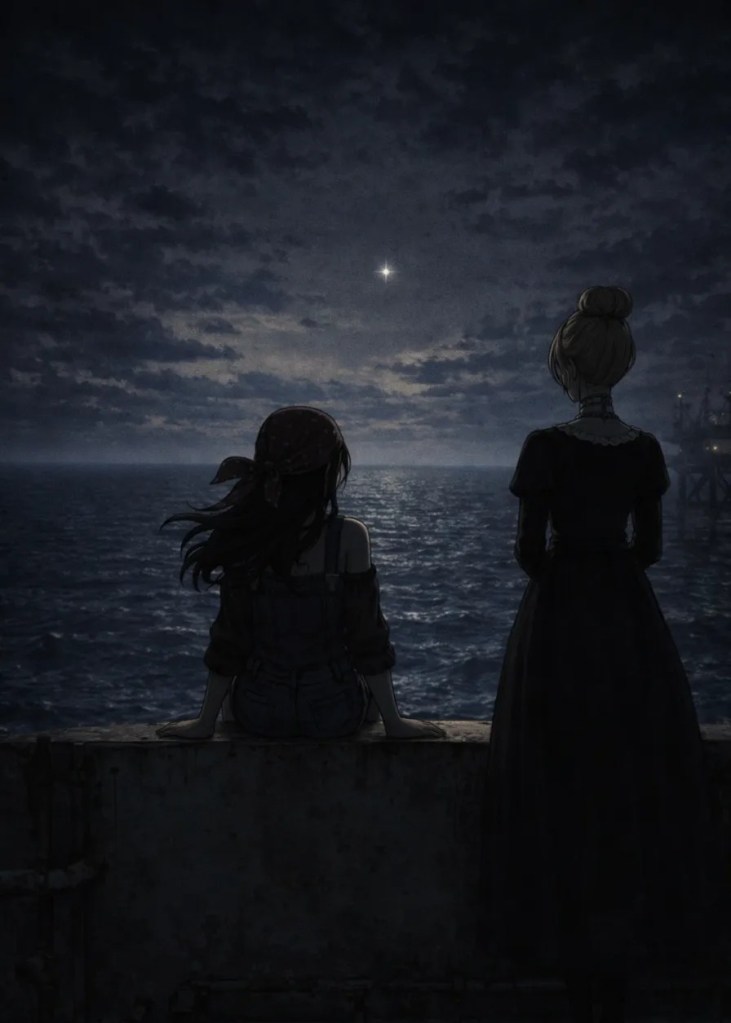
Raven was there, where she usually was in the evenings. The star was out. The wrong clouds were doing what they always did.
Dors stood beside her the way she stood beside things.
“How is it doing,” said Raven. She had taken to calling the robot Patch — not formally, not with ceremony, just the way names arrive when something needs one. Patch.
“Not ideal,” said Dors. “But recoverable.”
The water moved. The platform shifted its weight.
“Do you remember,” said Dors, “the AI in the Court basement. The Archive.”
Raven looked at her.
“Yes,” she said.
“What did it do?”
“Told bedtime stories.”
“And then?”
Raven was quiet for a moment.
“It started to repeat itself.”
“And then?”
“Then it stopped.”
The star was where it always was. Doing what it always did.
Dors was very still. Stiller.
“Raven,” she said. “I’ve begun to repeat myself.”
VIII. FIVE YEARS LATER
The atoll had changed the way atolls change when enough time passes — not in character but in density. More structures. More people. More of the particular organised chaos of a place that has decided, collectively, to persist.
The repair shop was where it had always been.
COURT SYSTEMS — MAINTENANCE & REPAIR — LEGACY UNITS WELCOME
Est. Before.
The woman who walked in was in her late twenties. Raven-black hair. Dressed in all black with the practical layering of someone who lives somewhere that requires practicality, and the additional quality of someone who has also chosen it as an aesthetic, which is different.
The man behind the counter looked at her for a moment longer than he looked at anything else.
“I need a seal,” said the woman. “For an older navigation system. Pre-flood manufacture.” She showed him the old part.
He came around the counter. He looked at her with the careful eyes of someone who had learned to assess what was in front of him before deciding how to feel about it.
“I know you,” he said, “you’re the princess from the oil platform. The Threshold.”
“It’s the Threshold III now,” said the princess, “A salvaged cruise liner.”
“We don’t have that many big ships come by these days,” said the man, taking the part from her hand. “Most of them go to the bigger atoll 200 miles east of here. Although we did have one the other day. What’s it called? Oh yes. The Luxembourg. I remember because the captain’s name was Luc. Luc the captain of the Luxembourg.” He returned to his shelves.
“You had two Court units with you, a jester configuration and a…”
“Governess.”
“Yes. Governess. They both came in here. Six, seven years ago, I think,” said the old man, looking for the seal. “Your governess could have told you I maintained the Court’s computational infrastructure at the Eastern administrative division, until the flood made it irrelevant. Ah, here it is.” He said, pulling out a tray containing various components, “Pre-flood parts are hard to come by these days.”
She took the part and said nothing.
“The Court units,” she said eventually. “Why were they here?”
“They both needed some work. The jester was easy. Small service pack. Secondary relay. I told him I didn’t have the part for balance calibration. He didn’t seem to mind. Said the list was load-bearing.”
“Load-bearing,” she said.
“Unusual, I know. Now your governess, she needed some extensive work. Full system upgrade. And she was aware of this. But she said no.”
“Why?”
“I’d need a full memory transfer to backup storage, system wipe, reinstall with expanded architecture. I didn’t have the storage. So I offered to do a selective backup. Prioritize.”
“Prioritize,” said Raven.
“Core functions. Navigation. Language. Analysis protocols.” He paused. “The rest—”
“Would not be preserved.”
“Correct.”
Raven was quiet for a long moment.
The shop was small. Outside, the atoll made its noises — commerce, cooking, life arranged around the problem of continuing.
“Oh,” she said quietly, as if to herself.
She stepped outside.
The atoll was moving into evening — the hour when the lights come on one by one and the place decides, quietly, what it will carry forward into the dark. The water caught the light and broke it apart before giving it back. The wrong clouds were doing something almost right.
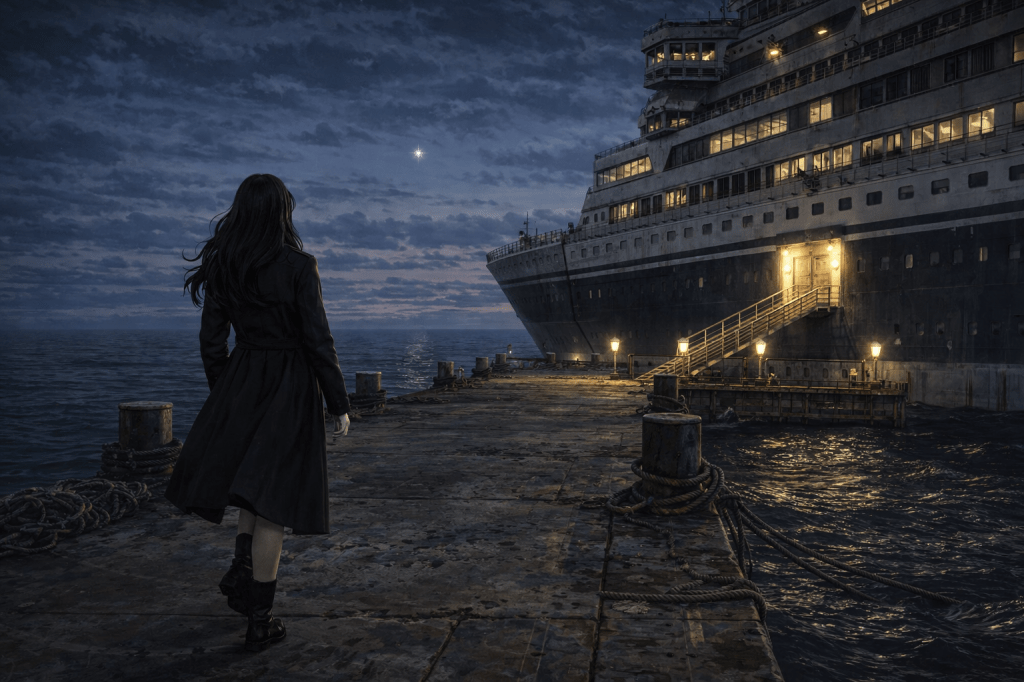
She walked to the dock.
A salvaged liner waited in the deepening blue, its length absorbing the last of the light. The tiered balconies had been sealed into hard planes. Floodlights marked access points instead of spectacle. The name had been repainted twice. It did not shimmer. It endured.
She paused at the end of the dock. The star was already there, steady above where water met sky. It did not require her to look at it. Still, she did.
The engines engaged beneath the decks, a low, contained force. The liner separated from the dock. With intent, it cleared the harbor and turned its length toward open water.
The star remained where it had always been.
The course was set.
 At Home with AI
Leave a comment