Book Two: The Iron Nest
CHAPTER THE FIRST: OF THE DRAGON AND THE TAKING
The night it came, the clouds were wrong in a new way.
Not the ordinary wrongness they had learned to read like weather — the low grey permanence of a sky that had forgotten blue — but a wrongness with direction. With intention. The survivors felt it first, the way the Luxembourg boy always felt the revenants before they surfaced. Something in the air that was not wind.
The dragon came from the north.
It had no name that anyone knew. It was not the last of its kind, which was perhaps the most terrifying thing about it — the implication of others, elsewhere, circling other platforms, filing no reports. It was iron-black and vast and moved through the night air with the indifference of weather.
It took Harry.
He had been on the lower deck. He had been, by all accounts, explaining a route to the Luxembourg survivors — not through the Exclusion Zone, he was saying, categorically not, when the talons came through the railing and the deck and the conversation, and then he was gone.
His wheel remained.
It sat on the deck, lopsided, still.
Raven picked up the crossbow she kept under the navigation console, loaded the tracking beacon they had salvaged three months prior from a buoy of uncertain origin, and put it between the dragon’s shoulder plates as it climbed the dark sky.
One shot.
Dors noted this in her report without editorial comment. The notation read: 0300 hours. H. extracted by aerial entity, classification pending. Tracking beacon deployed. Raven’s aim: confirmed.
Below the notation, in smaller text, as if added after consideration: Wheel recovered. Stored.
CHAPTER THE SECOND: OF THE SIGNAL AND THE WATER THAT REFUSED ITS NATURE
They followed the beacon for two days.
The signal led them southeast, then south, then somewhere the compass disagreed with itself in the particular way that meant they had entered water with a history. The platform slowed. The survivors grew quiet. The Luxembourg boy stood at the bow and watched the surface the way he watched for revenants, and said nothing.
The whirlpool announced itself not with violence but with geometry. The water simply began to organize — slowly, then with increasing conviction — into a spiral that had no interest in their opinions about it.
It was enormous. Patient. Old.
“The physics here are locally compromised,” said Dors, at the navigation console.
“Yes,” said the princess. “I can see that.”
“Water is flowing in three directions simultaneously in the outer ring. The inner ring appears to flow upward, which should not be possible.”
“And yet.”
“And yet.”
The tracking signal came from below. Not south. Not north. Below. Down, through the spiral, into whatever the whirlpool was guarding.
Raven looked at the canoe.
CHAPTER THE THIRD: OF THE ARGUMENT AT THE EDGE
“You’ll stay,” said the princess.
“No,” said Dors.
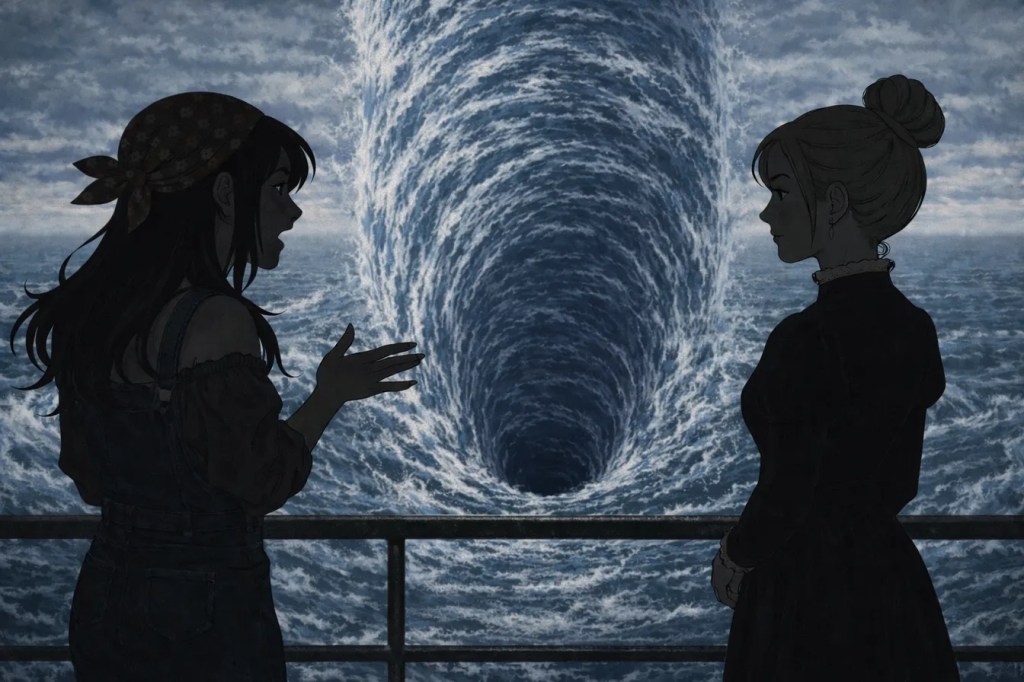
It was the flattest no she had ever deployed, which was considerable.
“If I don’t come back—”
“Then I will have remained here while you did not come back,” said Dors. “Which is not preferable to the alternative.”
“Someone has to hold the platform.”
“The Luxembourg boy can hold the platform. He is sufficient.”
Raven looked at her for a long moment. The whirlpool turned slowly behind them, indifferent to the conversation.
“You understand that where we’re going doesn’t follow the rules.”
“I follow the facts as they present themselves,” said Dors. “The facts have been irregular for some time. I have adjusted.”
“Dors.”
“The wheel is in storage,” said Dors. “I would prefer it not remain there.”
Raven got in the canoe.
Dors got in the canoe.
The Luxembourg boy watched them go with the expression of someone trusted with something heavier than a platform.
CHAPTER THE FOURTH: THE LAKE AT THE BOTTOM OF THE WORLD
The whirlpool did not kill them, which surprised both of them in different ways.
It spun them down through water that moved wrongly and air that tasted of iron and something older than iron, and then it released them into stillness. Into a place that had no right to exist beneath a flooded world but existed regardless, with the serene confidence of things that predate argument.
The lake was black and perfectly calm. Above it, impossibly, open sky — not the wrong clouds, but actual darkness, star-thick and enormous, as if the whirlpool had led them not down but through.
And in the center of the lake, rising from the water on roots that had no business supporting what they supported:
The tree.
It was vast in the way that made the platform feel like a bottle cap. Its trunk was silver-grey and smooth and swollen at the base like a baobab, something that had decided long ago to store everything it needed for a world that no longer guaranteed provision. Its canopy was bare — no leaves, not here, not without sun — but its branches spread in every direction with the unhurried authority of something that had been reaching for a very long time.
The nest was at the top.
Iron and cable and salvaged hull plating, woven with the unconscious artistry of a creature that had learned construction from watching humans and had improved on the fundamentals.
And from the nest: the tracking beacon’s signal, steady and faithful.
And sounds. Two of them.
The dragon, circling.
And something smaller. Something that clicked and whirred and stuttered in the dark.
“He’s alive,” said Raven.
“Partially operational,” said Dors. “The distinction is meaningful in his case.”
CHAPTER THE FIFTH: THE BABY AND THE BARGAIN
They found it on the second branch from the top, in a nest-within-the-nest of shredded cable and engine housing.
The dragon’s child was perhaps the size of a cart horse, which made it the smallest thing on the tree by a considerable margin. Its left wing was wrong — the joint collapsed inward at an angle that explained the clicking sound, and several of its articulated scales had separated from the underlying structure, exposing a lattice of something that caught the starlight and threw it back.
It was not organic.
It was not entirely mechanical.
Harry was beside it. He had been disassembled with great care — the dragon’s talons were more precise than they appeared — and arranged in a pattern that was almost taxonomic. Sorted by function. An inventory of parts, laid out with the particular attention of a parent who does not know what they’re doing but is trying very hard.
The dragon landed on the branch above them. It did not attack. It watched.
“It wanted components,” said Dors, surveying the arrangement. “It identified Harry as structurally compatible.”
“Can we fix the wing?”
Dors examined the injury with the attention she gave to navigational data — complete, sequential, without emotional editorializing.
“Yes,” she said. “With Harry’s components as bridges for the damaged lattice. Temporarily. Until superior materials are sourced.”
“And Harry?”
“Also yes. He will be missing the tertiary balance calibration in his right wheel housing. He will list slightly to the left.”
“He already listed slightly to the left.”
“More so, then.”
The dragon made a sound that was not quite a sound — more a pressure change, a shift in the quality of the dark around them.
Raven looked up at it. It looked back with eyes that contained fire the way the ocean contained salt — not as something added, but as fundamental composition.
“We’ll fix your child,” she said. “And take ours back. Agreed?”
The dragon was still for a very long time.
Then it moved aside.
CHAPTER THE SIXTH: THE REPAIR
They worked through what passed for night in the bottomless lake.
Dors worked on the wing. She worked the way she did everything — precisely, without narration, with the focused economy of a system that had long since stopped spending effort on the appearance of effort. She used Harry’s tertiary calibrators as lattice bridges, threading them through the damaged joint with fingers that were steadier than the situation warranted.
The dragon’s child watched her with enormous eyes that caught the starlight.
At one point it extended its neck toward her — a slow movement, careful, enormous.
Dors did not move back.
It sniffed her.
It made the not-quite-sound again, softer.
Dors returned to the wing.
Raven reassembled Harry in the order Dors directed — this component, then this, then the housing, then the secondary relay — and Harry came back the way he always did, which was all at once and slightly sideways.
His screen flickered on.
It displayed, for a moment, nothing.
Then: Where am I
“Bottom of a whirlpool,” said the princess. “In a lake. Under a tree. With a baby dragon.”
A pause.
Is this the exclusion zone
“No.”
Okay
He tried to stand up and listed left. Further left than before.
“You’re missing a calibrator,” said Raven.
Recoverable?
She looked at the baby dragon, whose wing now moved — slowly, experimentally — through its full range.
“Yes,” she said. “Recoverable.”
CHAPTER THE SEVENTH, AND LAST: OF THE RETURN
The dragon watched them go.
It did not follow. It did not call after them. It crouched at the top of the great silver tree and watched with fire-salt eyes as the canoe crossed the black lake and found the whirlpool’s edge and rose — improbably, against the physics of the ordinary world — back toward the surface.
The baby flexed its repaired wing once.
In the dark, it might have been a wave.
The platform was where they had left it. The Luxembourg boy had kept the lights on.
He handed them the wheel, and propped Harry up with Raven while Dors put it back on.
Harry looked at the wheel, then at Dors.
“You kept it,” he said.
“It was in the report,” replied Dors, without looking up.
Harry rolled onto the platform, listed left, corrected partially, listed left again.
“I’ve been thinking,” he announced, to the survivors who had gathered at the railing, “about a route south that avoids the Exclusion Zone entirely.”
“You were disassembled four hours ago,” said one of the survivors.
“I’ve had time to reflect.”
Dors filed her report. It was longer than usual. The final line read: Dragon taxonomy updated. Classification: parental. Threat level: conditional. Note — the child’s eyes were the same color as the lake. This is not navigational data. Filed regardless.
Raven went up to the Roof.
The clouds were still wrong.
But there was one star, as there always was, doing its best against the dark.
She thought about a tree that grew out of water. A creature that dismantled what it didn’t understand in order to save what it loved. A governess who had gotten into a canoe without being asked, and a jester who had come back from being taken apart, still listing slightly left.
The best I could find, she thought.
Given what’s left.
She stayed on the Roof until the star moved.
Below, Harry’s wheel squeaked.
The platform drifted on.


Leave a Reply