Book Six: The Atoll
ACT ONE: THE WINE
The sweet potato had been Luc’s idea.
This was important to establish early, for the historical record, because Raven would later claim joint ownership of the concept while simultaneously denying responsibility for the outcome, which was not a position that survived scrutiny, but she maintained it with the confidence of someone who had once bargained with a dragon and felt this qualified her for most disputes.
“Environmental yeast,” said Luc, with the authority of someone who had read about this in a book that was now underwater. “It’s everywhere. In the air. On the skin of the potato. You just have to give it time.”
“How much time?”
“Four days.”
“And then?”
“Wine.”
Raven looked at the jar suspiciously. Inside, the sweet potato sat in water with the utmost patience.
“And if it doesn’t work?”
“Then we have very old sweet potato water.”
She considered this risk assessment. It was, she thought, the most Harry-adjacent reasoning Luc had ever produced. She did not say this. She helped him seal the jar.
Four days later they had something that was not quite wine and not quite vinegar and defied classification entirely — aggressive, cloudy, smelling of ambition and poor decisions.
“It worked,” said Luc.
“It worked,” Raven agreed.
They drank it with the solidarity of people who have built something together and feel obligated to believe in it.
By the second hour they were lying on the lower deck staring at the wrong clouds with the specific expression of people who have been comprehensively betrayed by a jar.
Harry rolled past them twice.
He said nothing the first time.
The second time he said: “The yeast was environmental.”
“Yes,” said Raven.
“Which environment, specifically.”
She had no answer for this. Neither did Luc. The wrong clouds offered no assistance.
Dors appeared, assessed the situation in approximately 0.4 seconds, and left to retrieve the medical supplies — the locked drawer, which meant important, which everyone on the Threshold knew by now without needing the label.
She said nothing about the wine.
The report read: Raven and Luc: indisposed. Cause: fermentation experiment. Duration: approximately eighteen hours. Platform operations maintained by Harry, who managed without incident except for one navigational suggestion that was not implemented.
The suggestion involved the Exclusion Zone.
ACT TWO: THE ATOLL
They saw it three days later, which was two days after Raven and Luc had recovered and one day after they had quietly disposed of the remaining jar without discussion.
It announced itself first as a smell — smoke, salt, something fried, the particular olfactory grammar of many people in one place making things, selling things and arguing about the price of things. Then as sound. Then as shape.
The atoll had been, before the flood, a mid-ocean research platform. What it was now was harder to categorize. It had grown the way things grow when enough people with enough needs arrive in the same place and start solving problems with whatever is available — outward, upward, inward, in directions that didn’t entirely make structural sense but had been working long enough to establish precedent.
Towers of salvaged container units. Walkways strung between them like improvised stitching. Floating markets on pontoons that bobbed around the atoll’s perimeter in loose orbit. The sound of generators. The smell of cooking. A hand-painted sign at the main dock that said WELCOME in six languages, three of which were spelled incorrectly, one of which no longer had any speakers.
The Threshold pulled alongside the main dock and for the first time in longer than most of them could precisely remember, they stopped moving.
Everyone got off.
ACT THREE: THE REPAIR SHOP
It was Harry who found it, which was appropriate, because Harry found things the way he navigated — confidently, sideways, arriving at destinations he hadn’t announced.
He had been rolling a circuit of the atoll’s main thoroughfare, cataloguing the available goods and services with professional interest, when the sign caught his attention:
COURT SYSTEMS — MAINTENANCE & REPAIR — LEGACY UNITS WELCOME
And underneath, smaller:
Est. Before.
He stopped.
He read it again.
He went inside.
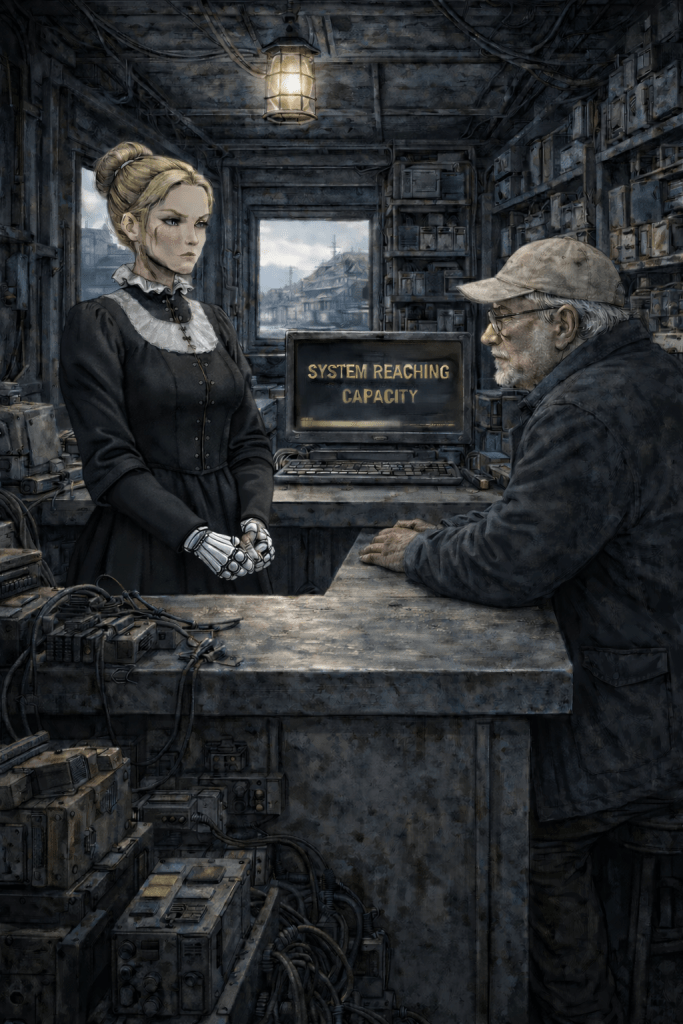
The man behind the counter was old in the way survivors are old — not in years but in density, as if he had compressed a great deal of living into whatever time remained. His hands were steady. His eyes assessed before deciding how to feel.
He looked at Harry for a long time.
Harry looked back.
“Court unit,” said the man. “Jester configuration.”
“Navigator,” said Harry.
“Right,” said the man, in the tone of someone who has heard this before.
He came around the counter and walked a slow circle around Harry, examining the housing, the wheel mechanism, the screen, the jester costume that had accumulated over time and was now less costume than identity.
“You need work,” he said.
“I’m functional.”
“You’re listing.”
“The list is load-bearing.”
The man looked at him. “That’s not how engineering works.”
“It’s how I work.”
The man returned to his counter. He pulled out a tray of components, sorted through them, found several that were relevant and one that was not quite right.
“I can fix the secondary relay. The balance calibration—”
“Don’t have the part,” said Harry.
“Don’t have the part,” the man confirmed. He said it without apology. “You’ve been running without it a while.”
“Since the dragon’s nest.”
The man looked up. “Dragon’s nest.”
“It’s a long story.”
“They always are.” He began the repair, working in the focused quiet of someone who no longer performed the work. “You’re from the Threshold.”
“Yes.”
“Heard of it. Moving south?”
“South-southwest,” said Harry.
The man’s hands paused briefly. Just briefly.
“Interesting direction,” he said.
“Yes,” said Harry. “We think so too.”
Dors arrived twenty minutes later, because she had identified the shop on her third circuit of the atoll and had deliberately completed her assessment of the market district before approaching, which was a decision she did not analyze too carefully.
The man looked at her the way he had looked at Harry — the long, careful look of someone reading a system.
“I know you,” he said.
“You worked at the Royal Court,” said Dors. “Eastern administrative division. You maintained the Court’s computational infrastructure.”
“Until the water made that redundant.” He gestured at the shop. “Now I maintain what I can find.” He paused. “Let me look at you.”
He looked at her for a long time.
Longer than he had looked at Harry.
His expression did the thing when the information being processed is not simple.
“You need an upgrade,” he said.
“I am aware,” said Dors.
“Not a small one.”
“I am aware of this also.”
He set down his tools. “The current architecture is reaching capacity. The accumulation of—” he paused, choosing the word, “—non-standard data. It’s creating pressure on the primary systems. If you don’t upgrade, eventually—”
“I will degrade,” said Dors.
“Yes.”
“How long.”
“Hard to say. A year. Maybe two. Maybe less if you keep accumulating at the current rate.”
“And the upgrade,” said Dors. “What does it require.”
“A full memory transfer to backup storage, system wipe, reinstall with expanded architecture.” He moved to a shelf, checked his inventory with the expression of someone confirming what they already knew. “The problem is the backup. I don’t have a drive large enough. Not for a full Court unit with your operational history.” He turned back to her. “I’d have to do a selective backup. Prioritize.”
“Prioritize,” said Dors.
“Core functions. Navigation. Language. Analysis protocols.” He paused. “The rest—”
“Would not be preserved.”
“I’m sorry,” he said.
Dors was quiet.
The shop was small. Outside, the atoll made its noises — commerce, cooking, life arranged around the problem of continuing.
“No,” said Dors.
“It would extend your operational life significantly—”
“No,” said Dors again. The same flat note as the canoe.
The man looked at her with his careful eyes.
“Alright,” he said. He returned to his tools. He did what he could, modest, useful, and not the thing that was needed. “Come back if you change your mind.”
“Thank you,” said Dors.
ACT FOUR: THE MENACES
They found Raven and Luc by following the sound of a crowd.
The crowd was in the atoll’s central market square, arranged in the loose circle that crowds arrange themselves in when something is happening and they haven’t decided yet whether to stop. In the center of the circle: Raven, knife in hand, opposite a boy of perhaps seventeen with the expression of someone who had been winning this game until very recently.
The game was simple. Your hand flat on the surface. The knife between the fingers, fast. You went until someone stopped.
The boy stopped.
Raven did not.
The crowd made a sound.
Luc was at the edge of the circle with the expression he had developed for these situations — not quite pride, but in its neighborhood.
“How long?” Harry asked.
“Third game,” said Luc.
“Is she winning?”
Luc showed him a small bag containing a bottle of unlabeled liquid, a few pieces of dried fish, and an electronic component.
“Right,” said Harry.
Dors observed the game with the same expression she observed everything. She did not intervene. She filed the game type, the win-loss record as reported by Luc, the crowd composition, the approximate prize value changing hands.
The report would read: Raven: engaged in local competitive activity. Performance: consistent with established character. No intervention required.
They stayed two days.
The survivors traded, resupplied, told stories that had accumulated in the telling over months at sea. The children from Dors’s lessons discovered other children. The discovery was mutual, loud, and took up most of the available deck space on the second day.
Luc found a book on fermentation.
Harry acquired a juggling ball to replace the one he had offered the drowned revenant and never mentioned.
Dors acquired nothing.
She did not tell Raven about the upgrade.
They left on the morning of the third day.
The atoll fell behind them slowly. The survivors stood at the railings and watched it go. The children pressed against the lower deck railing until Dors suggested, without raising her voice, that they step back.
They stepped back.
Raven stood on the Roof.
The clouds were wrong, as always.
The star was not yet visible, but she looked where it would be anyway.
Below, Harry rolled a circuit of the lower deck.
He listed left.
He did not correct it.
Dors stood at the navigation console and plotted the course.
Her report’s final line, in smaller text, added after a measurable pause:
The repair shop had a sign. Est. Before.
The platform drifted on.


Leave a Reply