The Merchant of the Deep
CHAPTER THE FIRST: OF THE SHIP MERIDIAN AND HER TERRIBLE LARDER
Call it hunger. Not the sharp hunger of a missed meal, but the long low hunger of seventeen days on half rations, the kind that settles into the bones like salt water into timber, patient and thorough and without mercy.
It was the lookout — a boy of fourteen who had survived the flooding of what had been Luxembourg — who first spotted the Meridian.
She was a proper vessel. Three decks. Running lights. The unmistakable silhouette of a ship that had not merely survived the world’s drowning but had perhaps profited by it.
“She’s riding heavy,” said Dors, at the railing. “Cargo.”
“Food,” said Harry.
“Possibly.”
“Definitely.” He said it with the conviction of a man who had not eaten adequately in seventeen days and had therefore promoted his hope to the status of certainty.
The princess said nothing. She watched the Meridian and the Meridian watched back.
CHAPTER THE SECOND: OF THE NEGOTIATIONS AND THEIR EARLY FAILURE
The captain of the Meridian was a woman called Voss who had, before the water rose, been an insurance adjuster. She had transferred her skills seamlessly. She stood at her railing and looked across the gap at the Throne — the Roof — and its occupants, and she calculated.
“We have dried fish,” she called. “Grain. Preserved citrus. What do you have?”
Raven looked at Dors.
Dors looked at Raven.
“Navigation assistance,” said Raven. “Medical knowledge. Labor.”
“Got all three,” said Voss.
A silence broken only by the water and the slow creaking of both vessels against each other’s patience.
It was one of the Luxembourg survivors who said it first. He meant it helpfully. He genuinely did.
“What about the jester?”
Every head turned.
Harry’s wheel stopped squeaking.
“He’s very— he knows things,” the survivor continued, losing confidence steadily. “He could— entertainment value—”
“No,” said Raven.
“He does navigation—”
“Incorrectly,” said Dors.
“He’s enthusiastic—”
“No,” said Raven again, in the tone that closed rooms.
Harry, to his credit, said nothing. His screen displayed what might have been dignity, or might have been the face of a machine that had briefly considered whether it was worth being traded for dried fish and had decided it was not.
CHAPTER THE THIRD: BEING AN ACCOUNT OF THE BRIDGE, OR RATHER THE PLANK
It was Dors who proposed the alternative. She proposed it the way she proposed everything — without preamble, without theater, with the calm of a ledger finding its balance.
“A contest of knowledge,” she said. “Three questions per party. Correct answers trade at market rate. Incorrect answers forfeit the equivalent in cargo or service.”
Voss considered this. She had been an insurance adjuster. She understood risk assessment.
“Who sets the questions?”
“We alternate.”
“Who judges the answers?”
“The water,” said Harry.
Everyone looked at him.
“It doesn’t care,” he said. “It’s impartial.”
Dors processed this for 0.3 seconds. “The sentiment is structurally sound even if the methodology is unclear. We judge by consensus.”
Voss agreed. A plank was extended between the two vessels. Not because it was necessary. Because it felt right. Some rituals survive the flood.
CHAPTER THE FOURTH: THE QUESTIONS AT THE PLANK
Voss went first.
“What,” she called across the plank, “is the last confirmed latitude of the Northern Provisioning Station?”
Dors answered before the question had fully finished arriving. The number was precise to four decimal places. Voss checked it against her charts and said nothing, which was its own answer.
Raven stepped forward for the Court’s first question.
“What is the weight of grief?”
A long pause from the Meridian.
“That’s not navigational,” said Voss.
“No,” said Raven. “It isn’t.”
Another pause.
“It’s different every time,” said Voss, finally. “Heavier when you’re not expecting it.”
Raven nodded. “Correct.”
Harry rolled to the plank for the second question from the Meridian. Voss looked at him with the expression of a woman doing fresh calculations.
“What,” she said slowly, “is your purpose?”
Harry’s screen flickered. It was, in the context of the plank, a larger question than its grammar suggested.
“To experience,” he said. “To be recoverable.”
Dors filed no objection.
The second question from the Court came from Dors herself, who walked to the plank and stood as she always stood, hands clasped, face unaltered by context or ceremony.
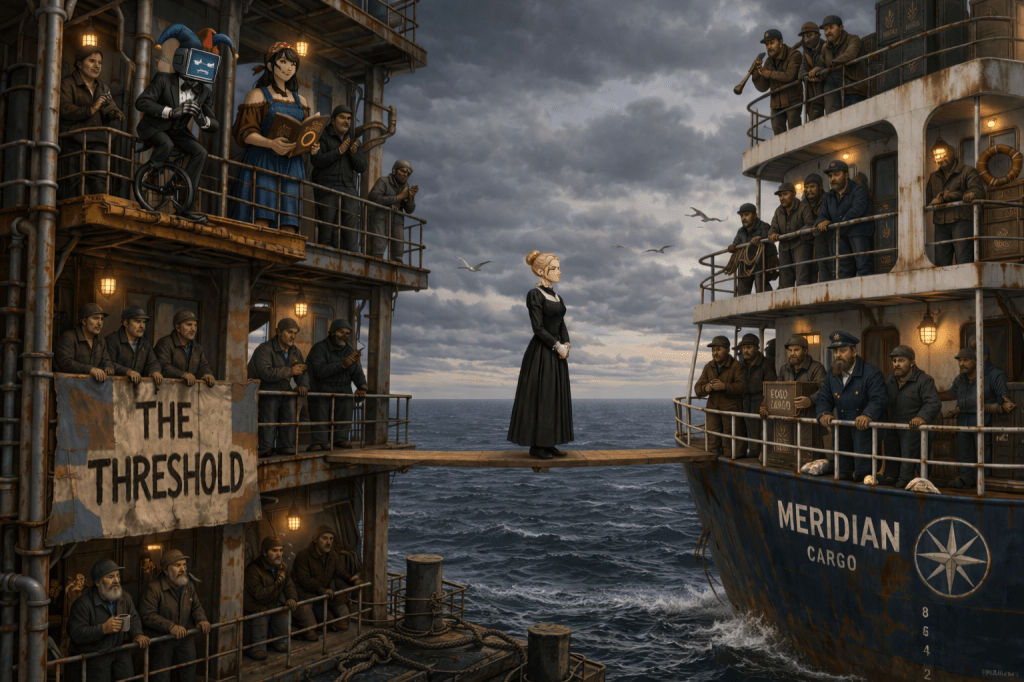
“What do you carry,” said Dors, “that is not in your manifest?”
The crew of the Meridian shifted. Voss was still for a long time.
“Hope,” she said, at last. “It doesn’t weigh anything, so I never list it.”
“Correct,” said Dors. And something in the word was warmer than her usual deployments of it.
The third question from the Meridian came from a young man at the back of the crew who had not spoken before. He pointed at Harry.
“What’s the capital of Assyria?”
Harry’s wheel spun once in place.
“…Nineveh?”
The young man blinked. “I don’t actually know. I just wanted to ask.”
“That’s not how this works,” said Voss.
“It worked fine,” said Harry.
CHAPTER THE FIFTH: THE SETTLEMENT
They traded that evening. Dried fish, grain, and preserved citrus for three weeks of navigational assistance from Dors — logged, precise, and delivered without flourish — and a single performance from Harry, who juggled on the joined deck while both crews ate together for the first time in months.
He dropped one ball.
He recovered it.
Raven watched from the Roof — the Throne — and did not call it a throne, just then. Just a roof. A high place above the water where you could see where you’d been, guess at where you were going, and know that the difference between the two was everything.
Voss appeared beside her as the light failed.
“The governess,” she said. “She’s not just a governess.”
“No,” said Raven.
“And the jester’s not just a jester.”
“No.”
Voss looked at the water. “What are they?”
Raven considered this with the patience of someone who had learned to think in open ocean.
“The best I could find,” she said. “Given what’s left.”
The Meridian pulled away at dawn. The platform drifted on. Below, Harry was already explaining to the Luxembourg survivors that he knew a route south, and that it was absolutely, categorically, not through the Exclusion Zone.
Dors filed her report.
The clouds remained wrong.
The platform drifted on.


Leave a Reply