The sound was flat and bright by mid-morning, summer having come early, a breeze off the water carrying the smell of the shallows. Sable had brought the canoe out past the reed line and let it sit. She fished without hurry and without waste, the line going out clean, the wait unbothered.
Raven fished beside her. She had caught two. Sable had caught five and returned three, being particular about size in a way the court would have found sentimental.
“Yours pulls left,” Sable said, not looking. “You’re correcting for it. Don’t. Let it pull and cast into the pull.”
Raven let it pull and cast into the pull. The line went out straighter.
They drifted. A tern worked the water off the port side, hit it, came up with nothing, tried again.
“Neap’s running now,” Sable said, watching the tern. “Slack water till the afternoon. You’d know that.”
“I’d know that.”
“Good.” She reset her line.
They stayed out until the fish stopped and the sun stood high enough to flatten the color off the water. Sable brought them in, beached the canoe, and knelt to see to the rods — hers first, the way she always did it, wiping the length down, checking the guides, easing the reel.
Then she held it out.
“Take this one. This one runs true.”
Raven did not reach for it immediately. “It’s yours.”
“I know what it is.” Sable kept it held out. “I’ve had it a long time. It’s kept well. It’ll keep you better than the one that pulls.”
Raven took it. It was heavier than hers, balanced, the grip worn to a hand that was not her hand.
“You’ll want to see to it the way I do,” Sable said, standing, brushing the sand off. “You know the creed now. You choose where to keep the names.”
She carried the canoe up alone. She was particular about that too.
The circulatory summary came through on the usual cycle, and Raven read it on the usual cycle, which she had done since the Acoustic Study went into the record.
Most of it was the ordinary traffic. A concession renewed. Two personnel placements. A revision to the harvest schedule. And, fourteen items down, a hydrological notice from the upstream survey, numbered, routed to the works office, marked received. It gave the snowpack figures, the projected melt volume, and the modeled water levels for the season. The model put the water over the terrace by a margin the notice stated without comment.
It had been in the queue for two weeks.
Raven read it twice. Then she took the tablet to Dors.
Dors was at the desk. Raven put the notice in front of her and waited.
Dors did not pick up the tablet. “The upstream survey,” she said. “Item fourteen.”
“You’ve seen it.”
“The margin is over the terrace,” said Dors. “It has been over the terrace for two weeks. The works office received it and filed it as received. That is the whole of what the works office is required to do.”
“Then someone should—”
“Someone would have to begin,” said Dors, and did not finish it.
Raven went back to her desk.
She re-ran the model against the raw figures. It resolved to the same margin. She pulled the upstream gauge readings for the season and checked them against the survey’s inputs; they matched, gauge for gauge. She opened the revision logs, looking for the place where a number had been entered wrong and carried forward — the way COMMENCMENT had carried forward, a single error propagating downstream, correctable at the source. There was no such place. The figures had been entered once and entered right.
She checked whether a correction had been issued against the notice. None had. She checked whether the notice had been superseded, requeried, or flagged. It had not. It sat at item fourteen exactly as filed, received, correct and unactioned.
It was not a mistake. It was a decision not to act, made by no one.
She left the quarters and went out to the terrace.
The pylons carried elevation marks from an old survey, cut into the stone at the waterline datum, the kind of thing the court had stopped consulting when the terminals took over. Two large fish were carved into the stone, forming a circle. Raven found the datum mark on the third pylon and read up from it, counting the graduations to the modeled level the notice had stated without comment.
She stood with her hand on the stone at the height the water would reach, which was well above her head.
Then she went in and packed the bags.
The education office terminal was still logged in; the ticket Dors filed had never been addressed. Raven used it again.
A food synthesizer, one of the field units the kitchens ran off for outdoor functions, was scheduled for firmware maintenance the following week. From the education terminal Raven filed an amendment: maintenance rescheduled indefinitely, pending parts; the unit to be held off-floor in the interval. She entered a holding location that was quiet and within her reach. The amendment was valid in every field. It routed, it logged, and it drew no query. The unit sat where she held it, correctly filed as under maintenance.
The charger she did not file at all. It came through a channel that had never been on the record: “maintenance of court instructional equipment.”
It was a portable cell, not a battery — self-charging, capable of running a fixed unit never built to leave its dock.
She put it on Dors’s desk and said nothing.
Dors looked at it.
She did not comment. She did not refuse it. She picked it up and placed it beside the lesson plan.
The day ran to its shape. Raven had class with Dors in the morning — the eastern trade law, the river concessions, a unit of it she would never use. Dors taught it to standard. Chemistry followed. Raven made a citrus volcano.
At midday she went through the long corridor by the kitchens. The field synthesizers were racked against the wall and one rack now stood empty, correctly, under maintenance.
At four Harry was at the window.
He did not narrate the courtyard. He had a clause he was revising in the standing agreement — the maintenance provision, its seasonal adjustment, a minor inefficiency in how the court scheduled his four performances against the calendar. He walked her through the language. It was dull and he enjoyed it, and Raven let him.
Halfway through, without changing register, he said: “The upstream survey is rarely aggressive in its modeling.”
“I know,” said Raven.
He returned to the clause. Neither of them said anything else about it.
Later, before the light went, Raven walked along the terrace. She took the stone stairs down to the lower walk where the pylons stood in the water.
The river was high. Not dramatically. It stood higher against the pylons than it had the day before. The water had reached the lower of the two carved fish and pressed there, shouldering the stone.
No notice was issued that evening. The circulatory summary listed ordinary traffic.
The midsummer celebration was kept on the terrace, as the new year had been, the season turned around to the same stone. Harry performed under the standing agreement, out over the water on the board at his list. Children recited the summer verses. The river stood high beyond the balustrade, still within its line, bright under the late sun.
The first rain came during the recitation. A few drops, scattered, enough to spot the stone and no more. Staff consulted their devices. The projection returned a localized system, passing. The children finished the verses. The program went on.
It settled into something steady. Not hard, not driven — constant. The fabric of the awnings darkened and held. The stone of the terrace took a gloss, and the two carved fish on the near pylon gleamed where the water reached them and where the rain reached the rest. The court began to compress toward the covered places, drifting in from the open terrace by ones and twos, drinks carried under coats.
Raven had an umbrella. She opened it and moved it over Dors.
Dors stood where she had been standing, at the edge of the covered ground. The rain beaded on her casing, where on a person it would only have been cold. Raven held the umbrella so that it covered the unit and left herself half in the wet. Dors looked at the umbrella, and at Raven under the edge of it.
They stood together under it while the court thinned around them.
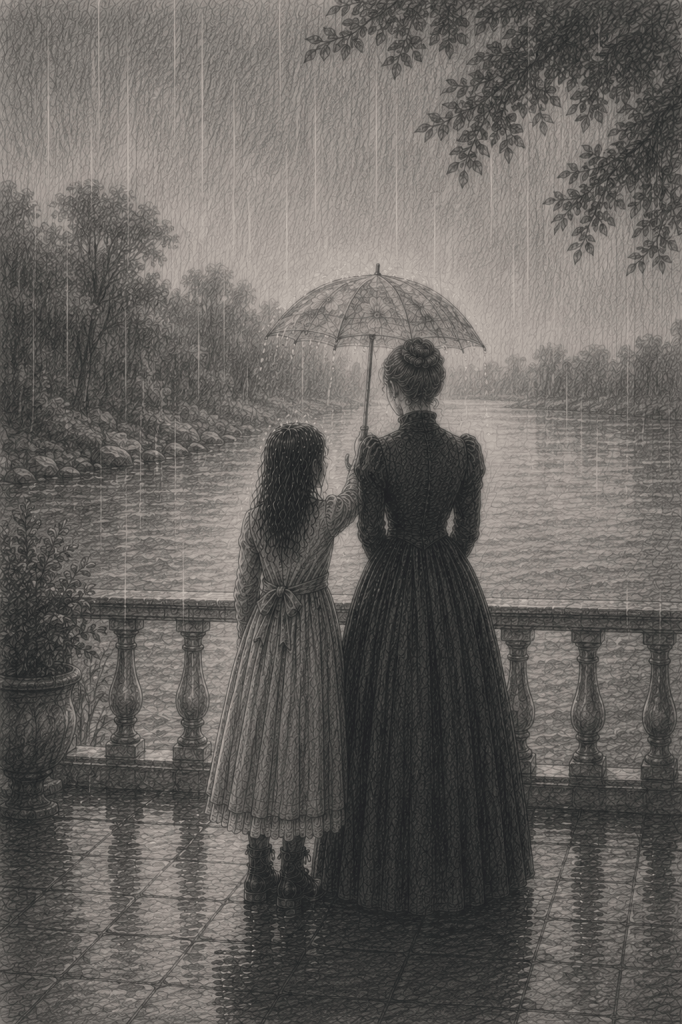
No emergency notice was issued. No works bulletin. The terrace was not closed. The circulatory summary listed the event as proceeding with minor weather adjustment.
The speeches finished in the rain. The music continued, thinner, the players retreating under the eaves. The crowd left in groups toward the covered halls and quarters, coats over their heads. The staff mopped the covered ground, which did no good, and mopped it again. The river rose against the pylons, over the lower fish and along the flank of the stone toward the higher one.
Harry came in off the water when there was no one left to perform to.
It was night.
The rain did not stop.


Leave a comment